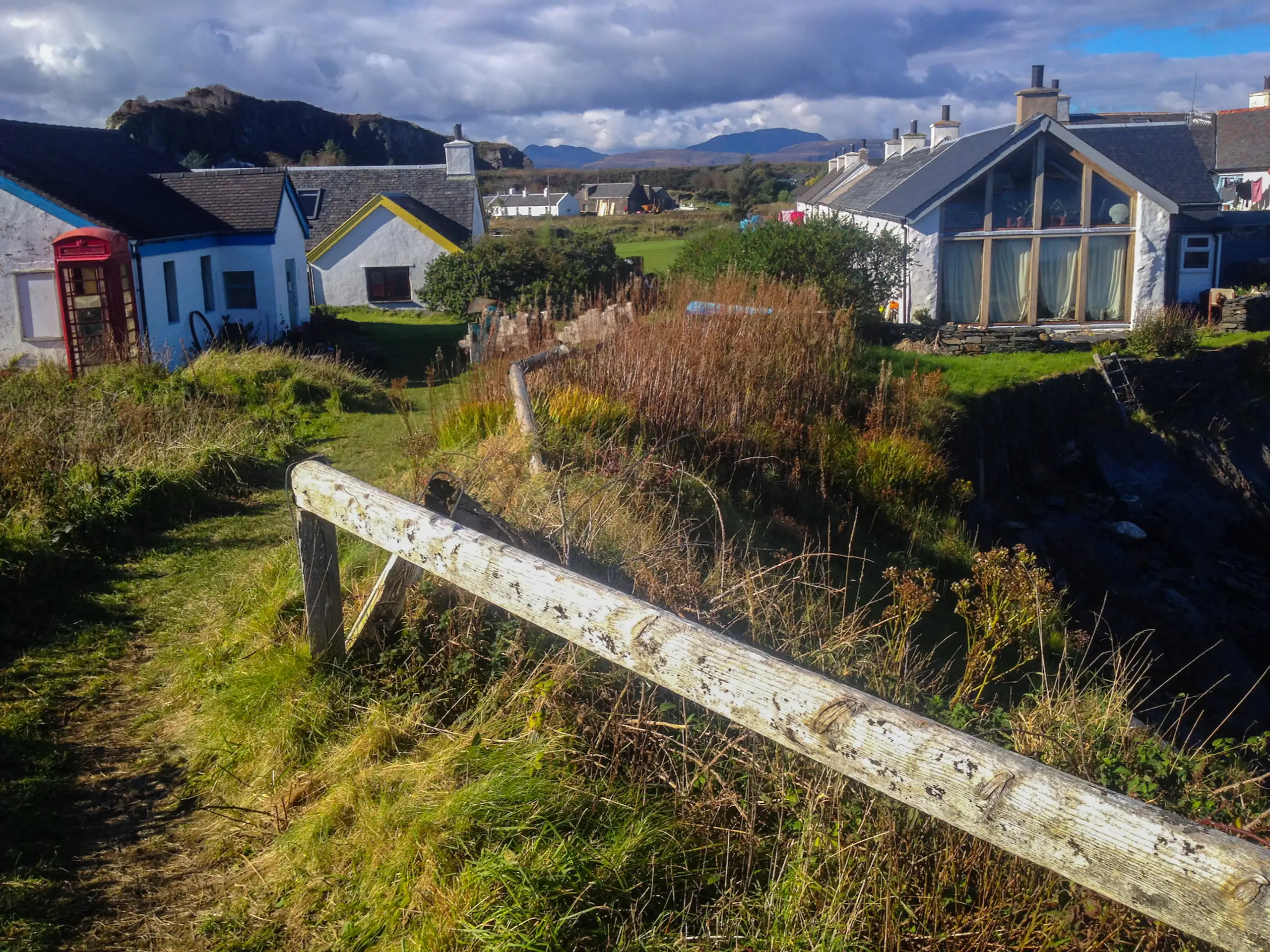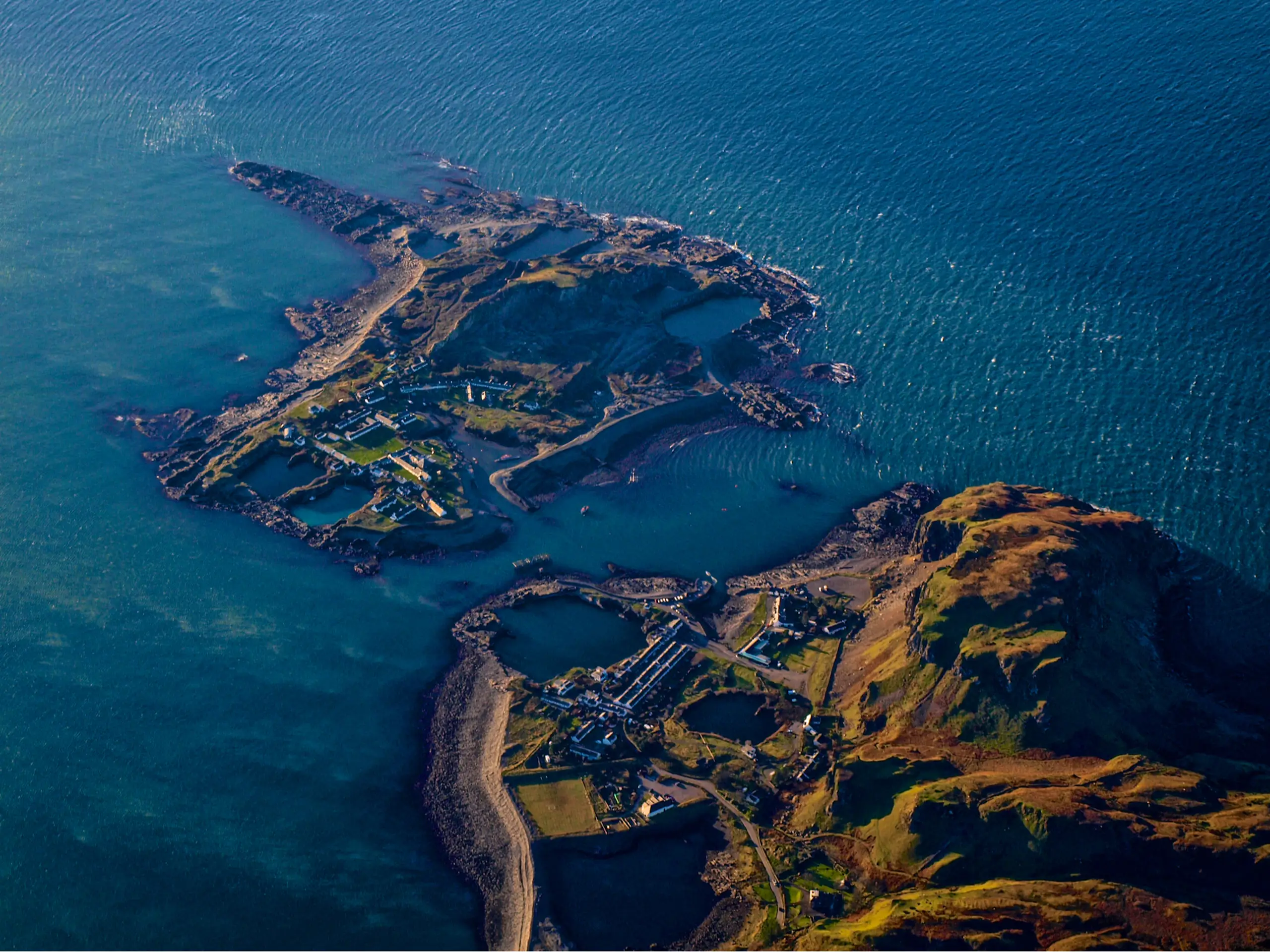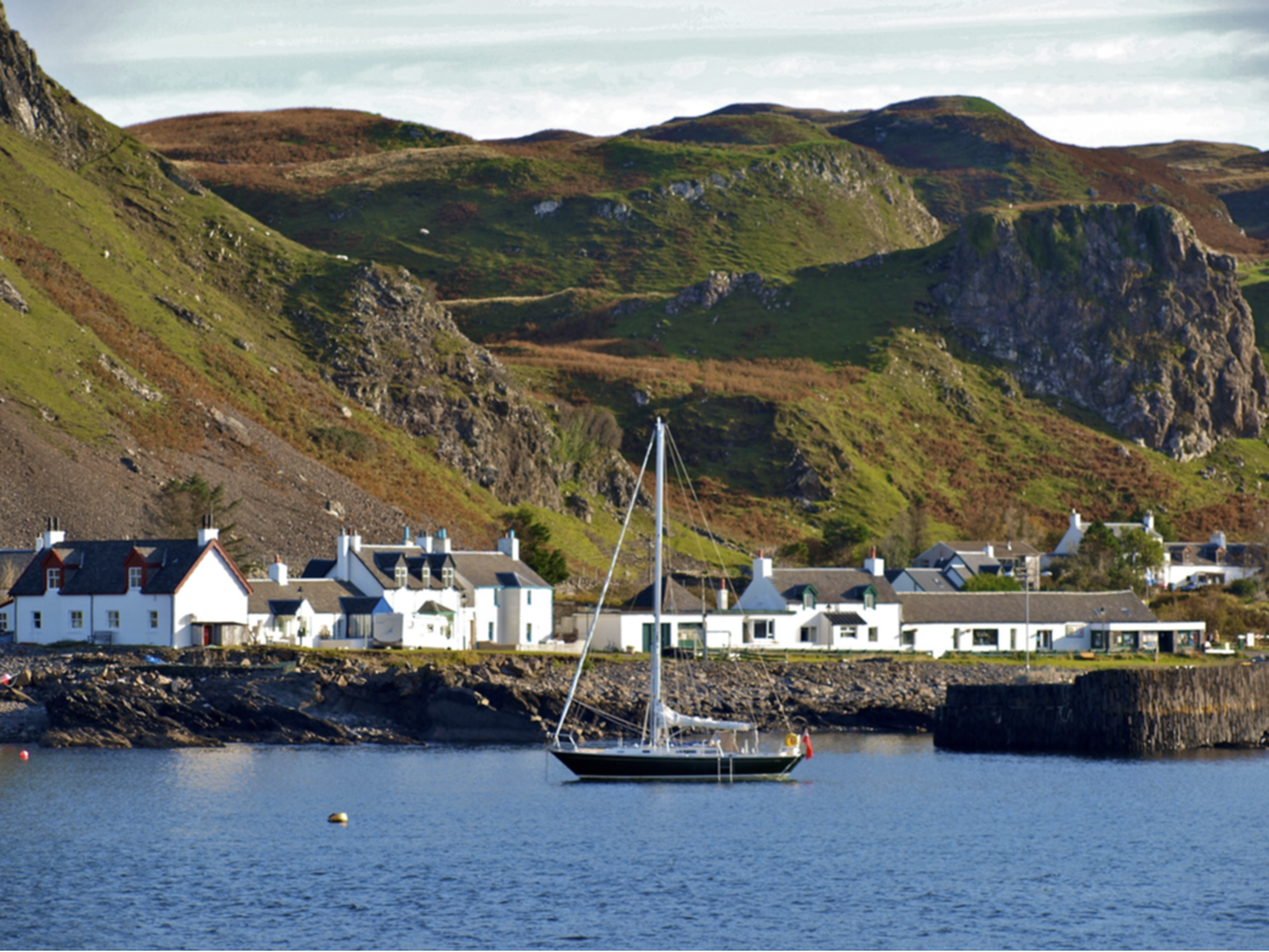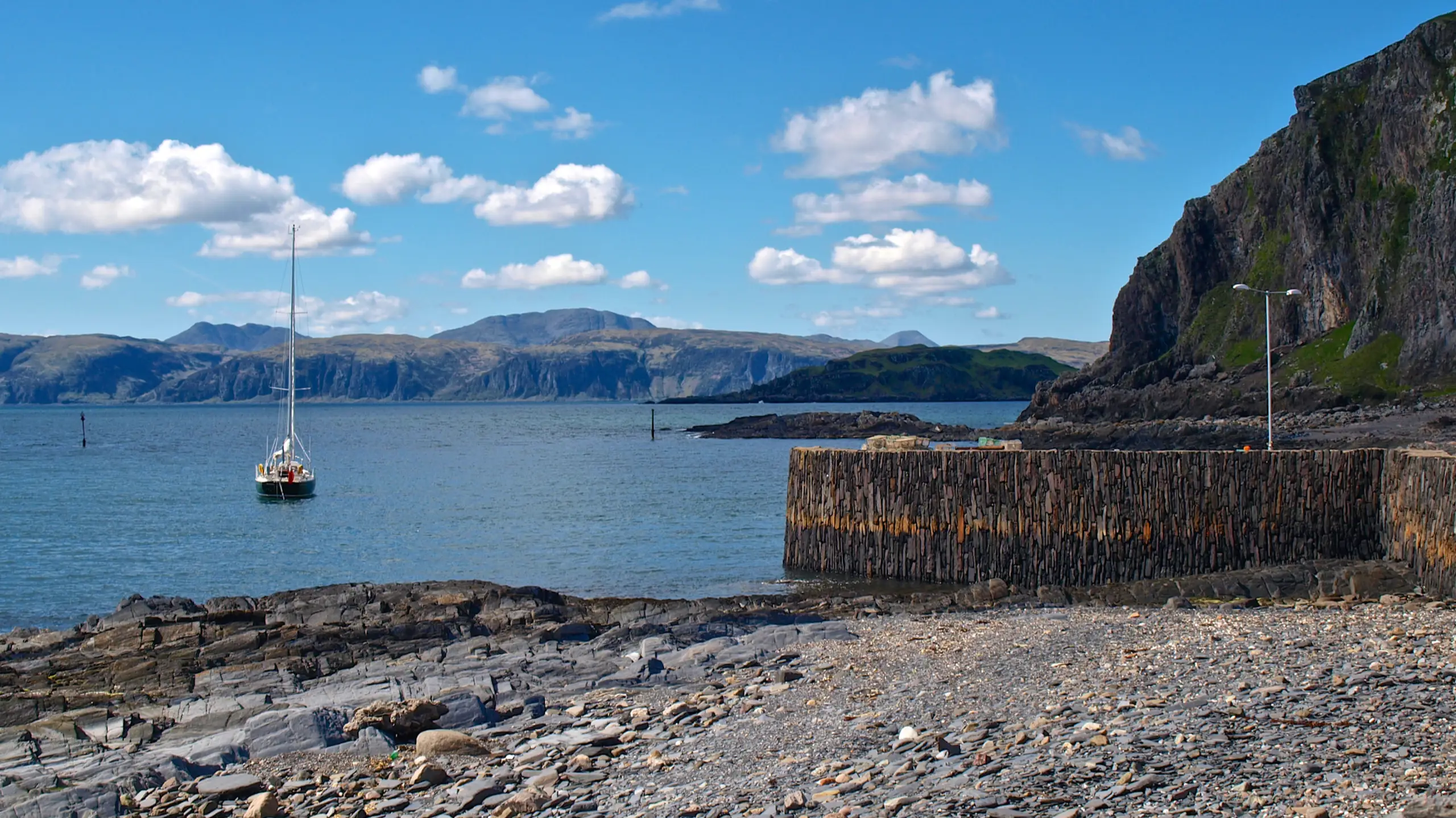
Easdale sound may be shallow and a bit tricky, but it is definitely worth stopping here to look round Easdale Island. This tiny car-less island once held a community of several hundred who were involved in slate mining, as they were at Ellenabeich across the short ferry ride to the mainland. Until in 1881 a storm breached the rock and masonry wall between the main quarry at Ellenabeich and the sea. By the time of the First World War all slate production had ceased, and the island community gradually disappeared, down to just four residents. But, gradually since the 1950s, the ruined workers' cottages have been taken over and restored by a new local community who are working hard to restore many of the island facilities, such as the drying harbour. And they are encouraging others to join them, in part by producing a short film on YouTube in 2015. Now apparently over half the population is resident.
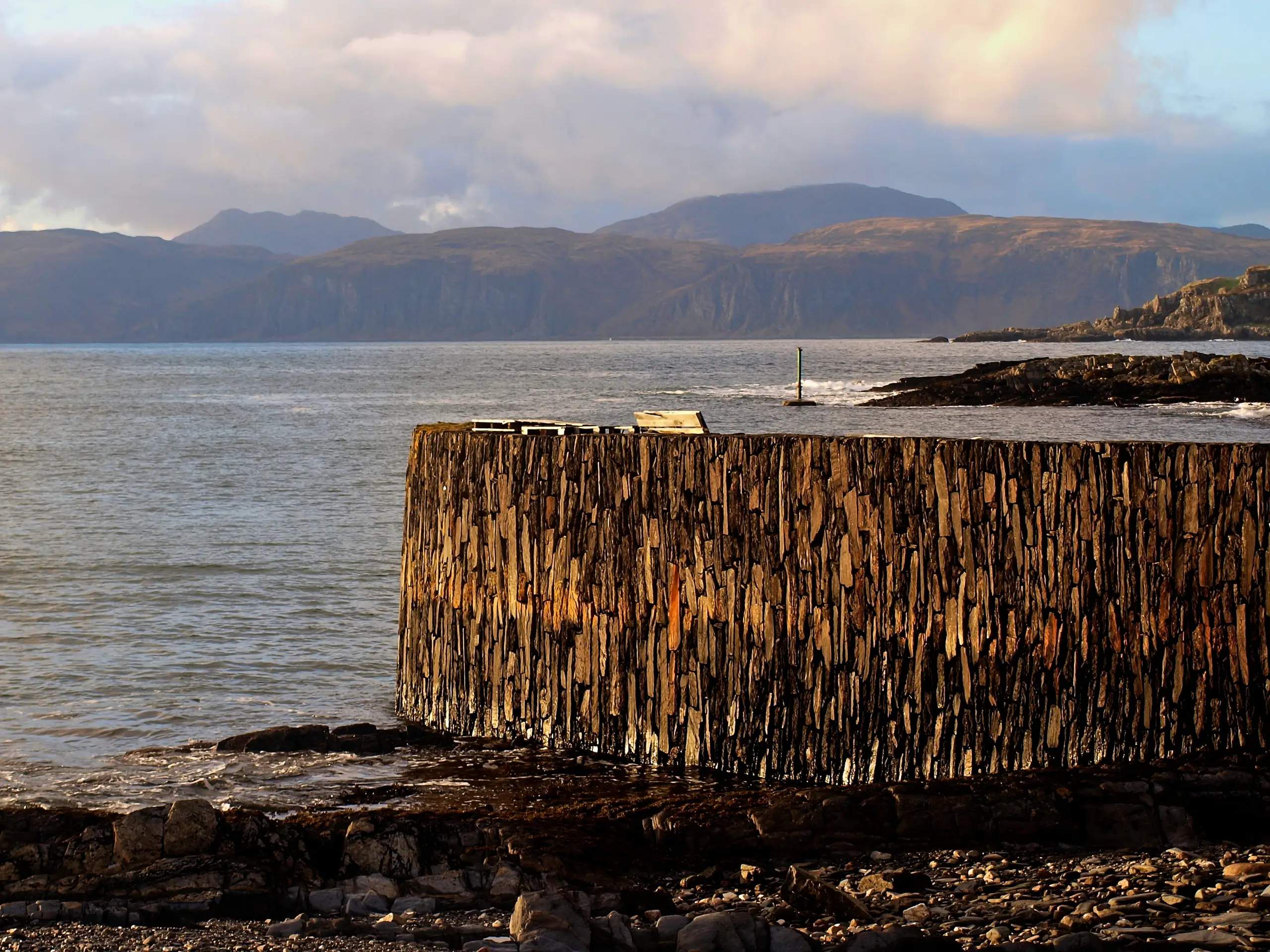
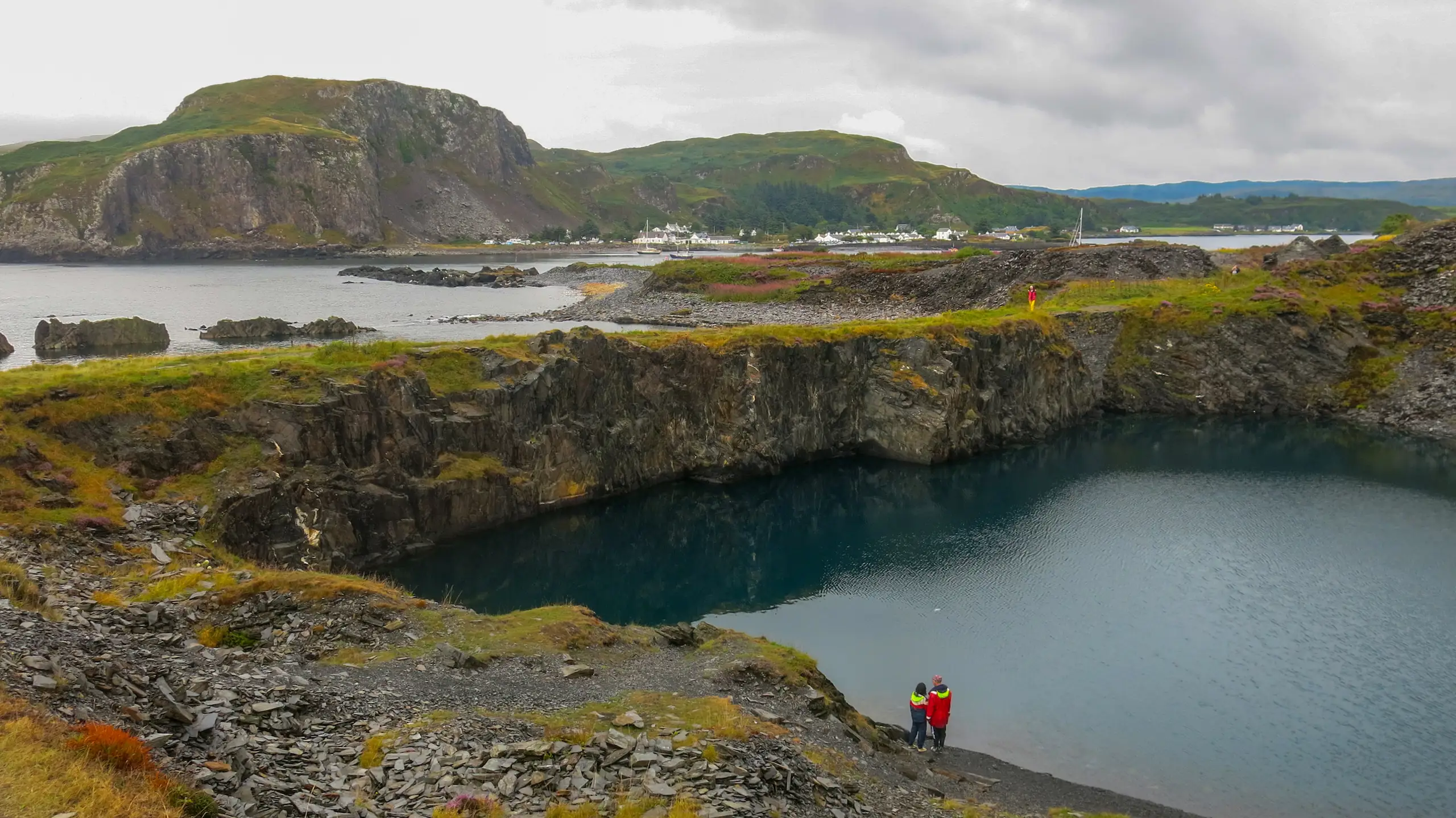
Everywhere you go there is slate — walls, piers, jetties, roofs, and under your feet. The early 19th century quays and jetties built of vertically orientated slate are particularly notable, and beautiful. Not surprisingly, given the whole place is made of slate, the annual World Stone Skimming Championships have been held here since 1983 (if you want to compete you have to buy your ticket the moment booking opens, even quicker than bagging a Glastonbury ticket). Twenty seven countries were represented in 2024, including Zimbabwe and Pakistan, with up to a maximum in 2025 of 400 competitors in total - so called 'chuckers'. But unless they understood colloquial English, I doubt if the non-English speakers would have appreciated the innuendo of being called 'tossers', or indeed of the final 'toss off'. I would qualify as 'an old tosser' as I am over, well over, 60. Entry £14 for adults, £7 for under 16s. Dougie Isaacs from Blairgowrie was the men's World Champion in eight out of 12 years, until in 2017 a Japanese man was the surprise winner (he was the Japanese champion so hardly a beginner). Then a Hungarian won the men's in 2018, and again in 2019! And an Irishman in 2024. Then in 2025, the inevitable as in all elite sports — a competitor was accused of cheating. He, or she, had doctored their stone in some way! It was an American. The organisers were, and maybe still are, trying to buy the venue, a flooded quarry, from the island's owner who at the moment charges the championship organisers a hefty fee.
The new(ish) community hall is a bit of an architectural mishmash — a combination of slate, wood, and lead roofing does not guarantee aesthetic success. I have not however seen the inside. Nonetheless, incorporated into this modern building, the Puffer Bar and Restaurant is a good combo (ph 01852 300022), but its future is uncertain (the pub is to be converted into a home). You were able to sit outside at tables admiring the view to Mull while eating cream teas, and watch the children swing on the swings The bar was small and cosy, but with no real ale which is no great surprise given the small population to drink it up before the barrel goes off.
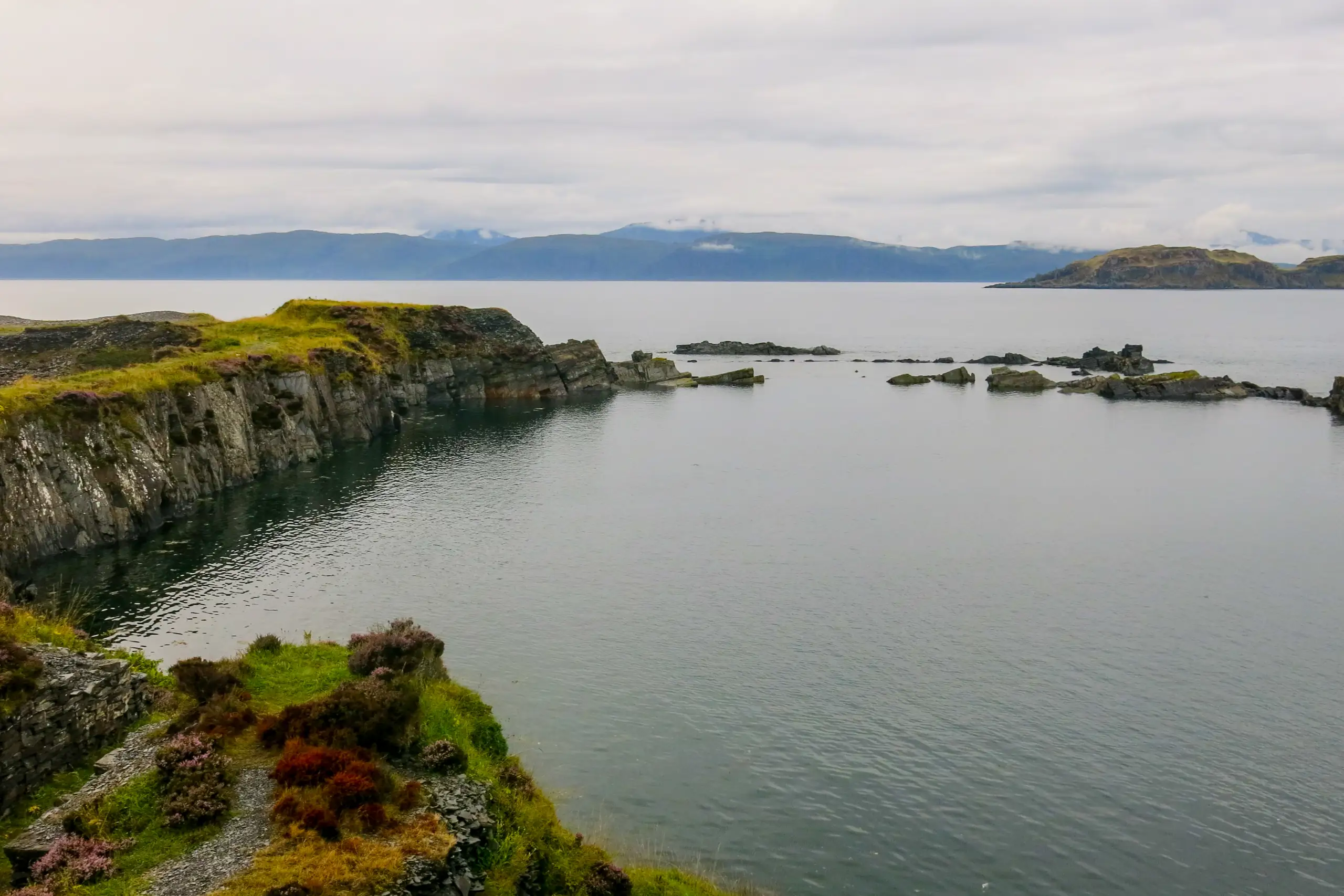
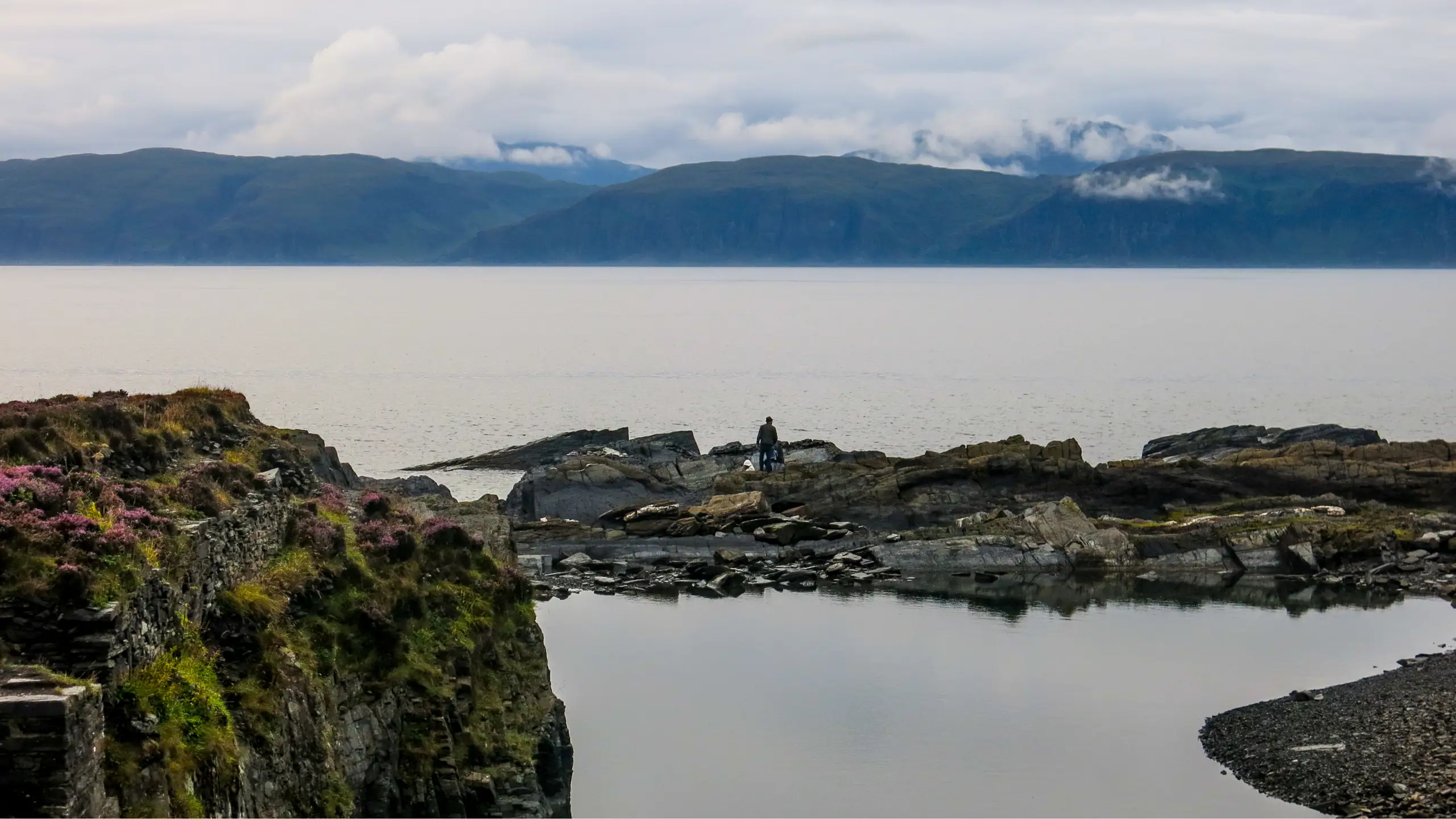
Make very sure to walk round the island to see the flooded quarries which are separated from the sea by just a few feet of rock. In the autumn there are loads of blackberries everywhere. The old cottages seem mostly restored now, and very charming they look too, many with gardens stuffed with flowers and shrubs. An old lamppost on the green seems to have been taken or stolen from 'The City of Lincoln'.
The small folk museum is a treasure and a delight. It was set up in 1980, and gradually put together lovingly over many years by Jean Adams who received an MBE for her efforts, much more deserving than the rather higher honours dished out to politicians and indeed to various of my old colleagues, often for no discernable reason other than doing their job well. She retired in 2006 and since then the museum has been owned by Eilean Eisdeal, the island's community development group set up in 1997. There are lots of original letters, objects of various sorts, and clippings from the Oban Times. Great!
Ellenabeich (Isle of Birches) is in fact no longer an island, it was quarried away. But the name lives on as the village on the Seil Island side of the sound. Here there was once a vast emporium of interconnecting caverns of tartan tat, the amazing and unique Highland Arts Centre. However, in 2017 the building was sold to Seafari who I think converted it into a boat shed, maybe with other facilities too. They run many of those tourist RIBs you see dashing round the nearby islands and are based here, a rather successful business it seems. They must be the successors of the "very able, extremely dextrous, and willing clever seamen" that The Hon Mrs Sarah Murray came across here at the end of the 18th century when writing probably the first travel guide to Scotland (A Companion and Useful Guide to the Beauties of Scotland, and the Hebrides ... to which is now added An Account of the New Roads in Scotland, and of a beautiful cavern lately discovered in the Isle of Skye'. The Hon. Mrs Sarah Murray. London. Third edition, 1810).
The Arts Centre was started by the late C John Taylor, an Englishman, with I would say dubious artistic talents, and a self-proclaimed poet as well as composer. When a coach rolled into the car park an elderly gent shouted, in a Yorkshire accent "ere coums a bous"! And a kilted youth stopped putting a ball on the green, picked up his bagpipes and let out a blast to welcome the tourist throng who were then disgorged from the bus into the emporium to emerge later with Scotland tea towels and plastic models of Robert the Bruce.
The cottages in the village are charming, presumably mostly holiday homes and lets. In one you will find the Slate Islands Heritage Centre run by a trust with a very informative website. Started in 2000, it is small but packed with interesting stuff, not just slate-related, so donate generously. Quite a lot of the village is now owned not by some distant landlord but by the Seil and Easdale Community Council.
The Oyster Bar and Restaurant does pub grub and real ale (maybe), but it seems to change hands rather frequently so it's hard to keep up with how it's doing or even whether it is still there in these difficult post Covid/cost of living crisis days (ph 01852 300121).
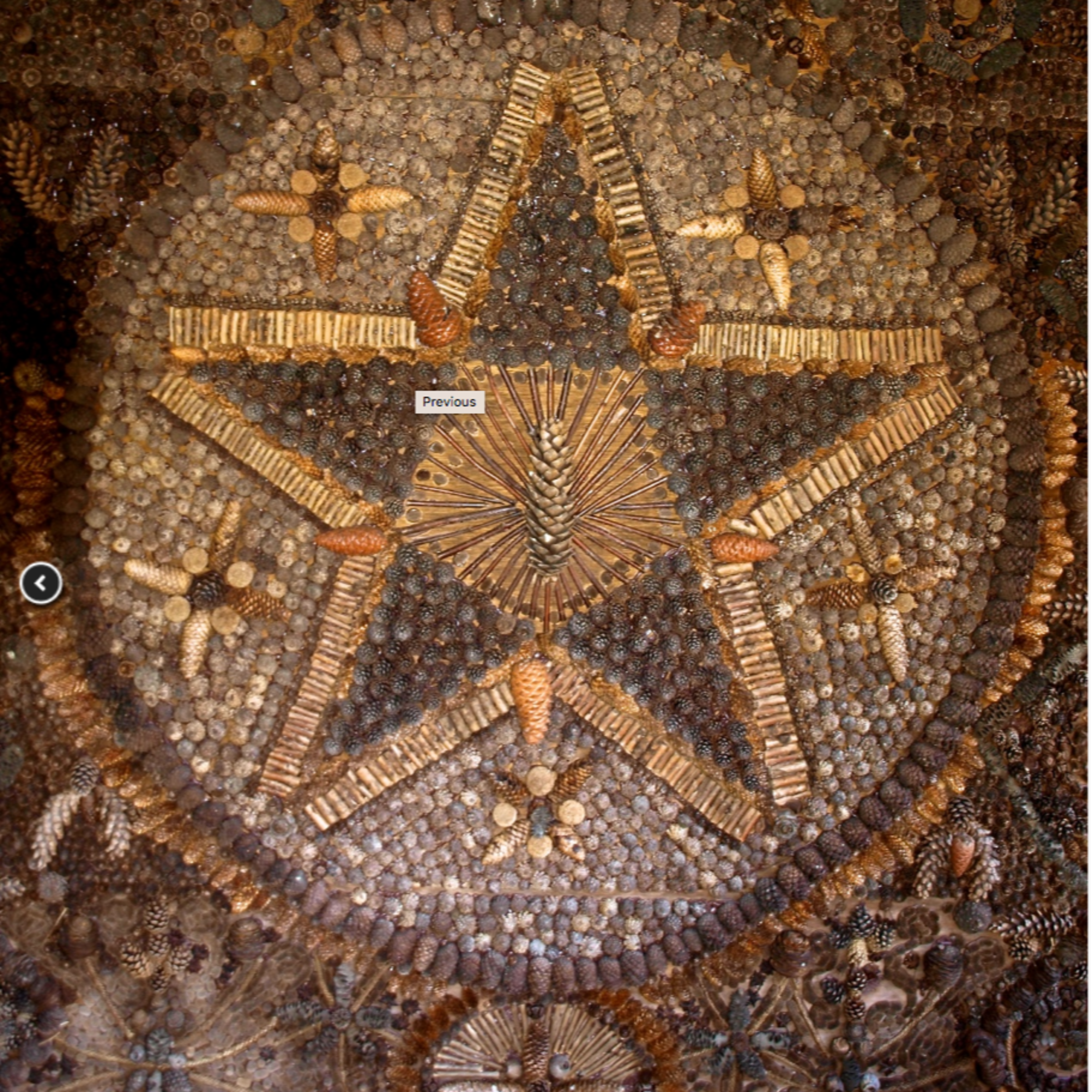
Finally, there is a beautiful garden created in the 1930s — An Cala — just along the road out of the village. It is small, charming and domestic. A lovely waterfall tinkles down a cliff and there is a wonderful summerhouse or temple with walls covered in patterns of pine-cones from all over the world. And look out for the flock of wire sheep. The house itself is actually a combination of three 19th century cottages which were converted into a single very nice looking house in the 1930s giving "an almost incongruous anglicised intimacy" according to 'Pevsner' (The Buildings of Scotland, Argyll and Bute. Frank Arneil Walker, Penguin Books, London, 1992). Thank you Mrs Downie for sharing all this with us for a mere £5 a head. So unlike the owners of Torosay Castle on Mull, Achnacloich on Loch Etive, and Jura House who have closed their gardens to the public. But, how sad, the whole place was up for sale in 2025.
And finally, much of the film of Gavin Maxwell's famous otter book, 'Ring of Bright Water', was filmed around here.