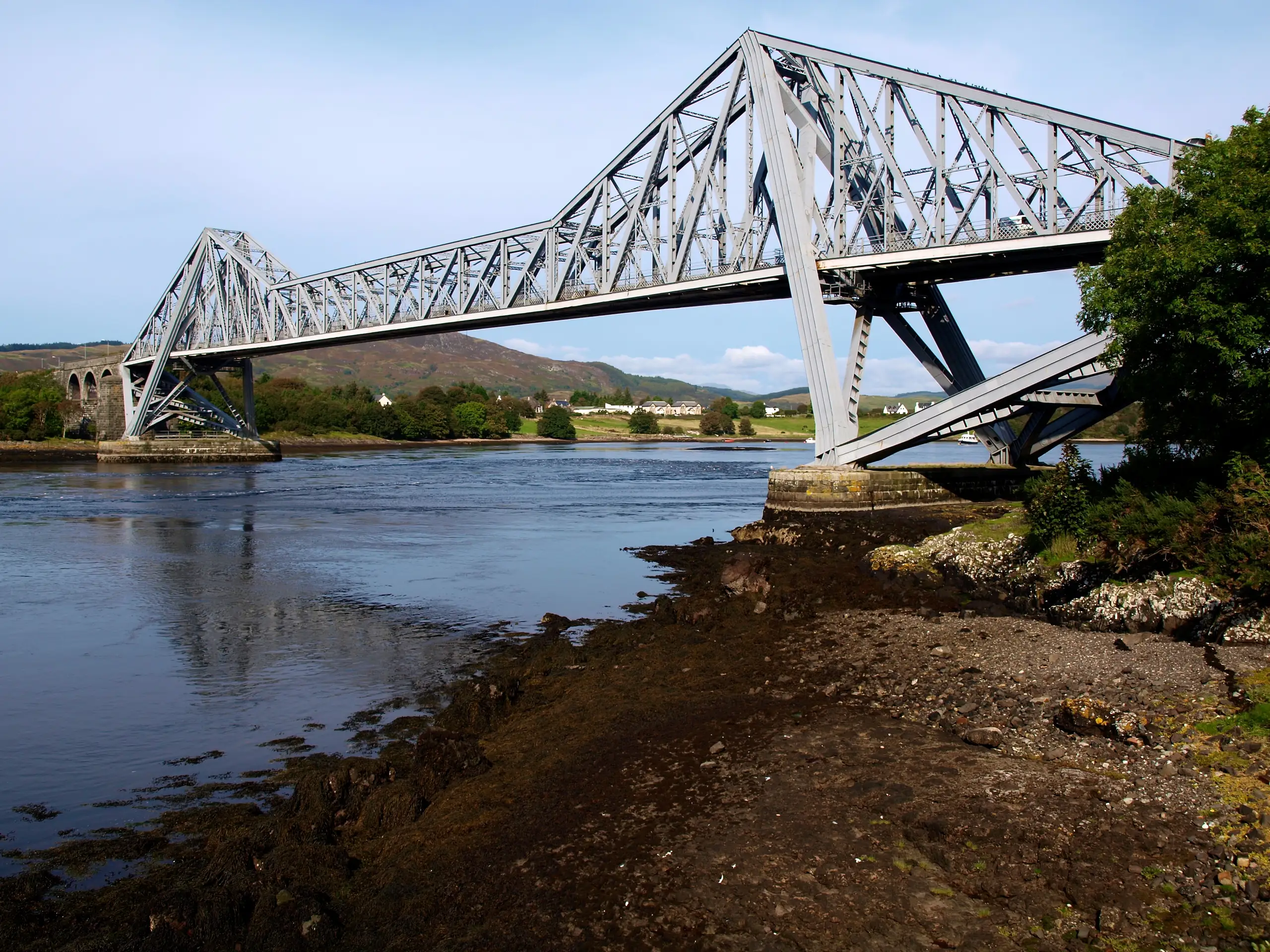
"To enter this loch is no easy task for a stranger, and as there are many more lochs quite as deep, quite as beautiful, and far easier of access, I should recommend that Loch Etive is looked at from the sea and left alone." So wrote Frank Cowper in 1896 (Sailing Tours: The Yachtsman's Guide to the Cruising Waters of the English and Adjacent Coasts, Part V, The West Coasts of Scotland, the Orkneys, and the west coast of the North Sea. Frank Cowper, Upcott Gill, London, 1896).
It must have been reading that, and the dire warnings in the modern Sailing Directions, that persuaded me for years to avoid the Falls of Lora at the entrance to the loch. But, summoning up courage and with my co-owner at the time, on one flat-calm sunny day in May, carefully planned at neaps, we gingerly motored under the Connel bridge and on through the Kilmaronag narrows to enter the loch. It was not a problem, nor as difficult as it appeared at first sight. Even the narrows at Bonawe were a doddle, keeping left to avoid electrocution. I certainly didn't make such a mess of it as C. C. Lynam 120 years ago: "The falls of Lora were in full roar, the tide being almost low. Hugging the south shore I was whirled along head to wind, which ought to have been aft, the dinghy led the way, and down the swirling decline went the Blue Dragon, stern first; only a few yards off was the great green waterfall over the central rock" (The Log of the ‘Blue Dragon’ 1892-1904. C C Lynam, AH Bullen, London, 1907).
It was then truly extraordinary to find myself amongst some of the highest mountains in Scotland, many of which are very accessible from the anchorages. All alone sailing up the upper loch with grand views ahead, and yet within a few miles of the hundreds of boats parked in Dunstaffnage Marina. This has got to be the best sea loch in the area, and one of the best in all of Scotland. There are a number of 'official' anchorages, and innumerable unofficial ones. Unfortunately I can't explore them now my mast is too high to get under the bridge.